
- charisrenzocathyware
-
 Jumat, 06 Februari 2015
 -
 0 Comments


Download Multimedia Programming using Max/MSP and TouchDesigner
The presence of this Multimedia Programming Using Max/MSP And TouchDesigner in this world includes the collection of many wanted book. Even as the old or brand-new book, publication will certainly provide incredible advantages. Unless you don't really feel to be tired every single time you open guide and read it. Actually, book is an extremely excellent media for you to enjoy this life, to take pleasure in the globe, and also to recognize everything in the world.
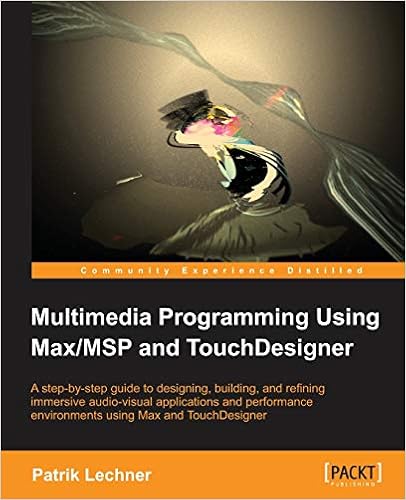
Multimedia Programming using Max/MSP and TouchDesigner

Download Multimedia Programming using Max/MSP and TouchDesigner
After few time, ultimately the book that we as well as you wait on is coming. So alleviated to obtain this excellent publication offered to present in this internet site. This is guide, the DDD. If you still feel so difficult to obtain the printed publication in guide shop, you could accompany us once again. If you have actually ever before got guide in soft file from this book, you could easily get it as the referral currently.
When you are truly fond of what phone call as publication, you will have one of the most favourite publication, will not you? This is it. We concern you to promote an intriguing publication from an expert author. The Multimedia Programming Using Max/MSP And TouchDesigner is guide that always comes to be a friend. We advertise that publication in soft data. When you have the soft documents of this book it will certainly relieve in analysis and bringing it almost everywhere. But, it will certainly not be as hard as the printed publication. Due to the fact that, you can conserve the documents in the gadget.
The book includes everything new as well as attractive to check out. The option of topic and title is actually various with various other. You could feel this publication as one of the intriguing book since it has some advantages and possibilities for transforming the life better. And now, this publication is offered. Guide is positioned with the lesson as well as information that you need. Yet, as straightforward book, it will not require much idea to check out.
Due to the fact that of this publication Multimedia Programming Using Max/MSP And TouchDesigner is marketed by online, it will certainly ease you not to print it. you can obtain the soft documents of this Multimedia Programming Using Max/MSP And TouchDesigner to conserve in your computer, gadget, and a lot more gadgets. It depends on your readiness where as well as where you will read Multimedia Programming Using Max/MSP And TouchDesigner One that you require to always remember is that reviewing e-book Multimedia Programming Using Max/MSP And TouchDesigner will endless. You will certainly have eager to check out other e-book after completing a book, and it's constantly.
About the Author
Patrik Lechner Patrik Lechner started making electronic music at the age of 16, and soon discovered environments such as Pure Data and Max/MSP. From then on, he developed many tools for his own experimental music, and it wasn't long after this that he started creating generative 3D visualizations of audio material. Since then, he has devoted nearly all his life to real-time audio/video processing and generation. Patrik worked as an audio engineer for an Austrian TV station for years, and taught Max/MSP both privately and at institutions. For instance, he conducted workshops for the audio engineers of the Burgtheater Vienna, and since 2012, he has been working for the University of Applied Sciences in St. Polten (FH St. Polten). Patrik has worked on many multimedia projects, for example, an installation at the Festspielhaus Baden-Baden for the Institut fur Creative\Media/Technologies, FH St. Polten, and an interactive audio installation in Dubai. As an artist, he did audiovisual performances in Austria, Italy, Germany, Mexico, Canada, and Dubai, and regularly played at the Austrian Pavilion at the world exhibition in Shanghai 2010. He worked a lot with classically trained musicians, developed a real-time scoring system/piece for a string quartet that premiered in 2012, and frequently works with painters and artists from other fields.
Read more
Product details
Paperback: 404 pages
Publisher: Packt Publishing - ebooks Account (November 26, 2014)
Language: English
ISBN-10: 1849699712
ISBN-13: 978-1849699716
Product Dimensions:
7.5 x 0.9 x 9.2 inches
Shipping Weight: 1.9 pounds (View shipping rates and policies)
Average Customer Review:
4.8 out of 5 stars
8 customer reviews
Amazon Best Sellers Rank:
#1,444,188 in Books (See Top 100 in Books)
Very good!!!
Stylistically, the Max package differs from most procedural languages and even from declarative languages like HTML. Max is a dataflow language. You can or should visualise what happens to your data in each module of processing. It is attuned for audio analysis, where this approach is fruitful. And professionals in this field have been trained in this natural way of thinking.One chapter on basic audio actually demonstrates sophisticated means of wave shaping, that come with Max by default. You do get a lot of powerful maths tools right upfront. The chapter is a quick skimming of how to use these to modulate your audio. Well, the following chapter calls itself advanced audio. Here, the screen captures show complex modules acting on the input audio. Like a compressor. Or how to do reverb easily.Actually, the book is quite advanced. Well suited to an audio engineer or electrical engineer. It gets into topics like Karplus-Strong synthesis (for a plucked string) that were once research level areas not too long ago.The discussion on video (ie. visual) algorithms also encapsulates advanced topics. Shaders are covered, where these are expected to run on the GPU of your machine. The images from the shaders that the book shows are all in black and white. Sorry, but for reasons of cost, the publisher needed to do this. Think of this perhaps as incentive to try the shadings out on your machines, to see the actual colours.
There is so much value in this book, I will try to highlight a lot of what I felt shined through for me. This review is more about the audio and synthesis side of this book.The book seems to be aimed at readers with a level of knowledge that stretches from an advanced beginner through intermediate skill levels. Going through Max example patches and the related reference docs has always been the best thing to do as a beginner. The documentation is great and has gotten better over the years. Even so, once one has put the time in with the docs, it is very helpful to have someone who is an experienced patcher to show some of the often unfamiliar visual programming patterns. This book fills that role very well. Though there is a lot of dense technical information, the author clearly elucidates how it all works together. Each chapter brings the reader step by step into the labyrinths of knowledge that is visual programming in Max.The early chapters present an indispensable discussion of foundational information for anyone who needs to get up and running with visual patching paradigms in Max. The author's techniques are not only useful in general, but also inspire the kind of thinking that visual programming really requires. Throughout the rest of the book, the subpatches / abstractions in his examples teach a lot on their own. For a motivated learner, there is a lot of time to be spent learning and understanding these. There is so much detail presented in patcher form alone, I recommend one keeps the chapter projects' windows open in Max as you move through the author's instruction. I know I will be digging through and experimenting with these for some time.There is an in-depth debugging discussion, which rounds out the practical programming methodologies presented for the individual topics. If one comes from a non-visual software background, some software paradigms are related to the patching environment. For instance an MVC approach is covered in the section for designing and scripting interface elements.The sections that deal with audio describe all the parts of a synthesizer and sampler that one might be interested in creating. There is an overview of the essential synthesis foundational information. The author shows everything from feedback, FM, filter theory, polyphony, sample accuracy, loading audio into buffers, and creating advanced samplers.If you are into effects, you don't go home empty handed, the author also shows some mixing and effects creation like tape delays. The techniques shown in the examples for the more advanced and non-user-facing aspects of building instruments are holistic best practices that can simply be used to solve problems without having to get too down and dirty. Along with all the components themselves, the way that they feed into and mix together is shown. This all makes for a concise and refreshingly complete learning path for the budding synthesist. I will now highly recommend this book because of these sections alone.The author speaks about his topics with an emphasis on clarity, but keeps the high level perspective in view throughout. He utilizes the max environment to create a well illustrated and in depth discussion of the various synthesis and sampling techniques.There is also a totally amazing section about reverbs and impulse responses and convolution, does it get any better?! yeah because then advanced fft effects are discussed. I learned a lot here and feel like I have somewhere to go from in order to get into all kinds of audio processing. I think the later parts of the book are where it is really up to the reader to be following along and studying the project patches as they read. This is laborious work, cause the urge to get creative isThere is a high level overview of gen, jitter matrices, and Max for Live. There are some cool examples of how to do things like implement karplus-strong synthesis and creation of filters in Gen. The author moves into some advanced physical modeling and further more advanced acoustics discussions ensue. I see this as part of the great mix of topics that define different levels of challenge for intermediate-level programmers.Some of the information, like the max for live section and the initial intro to jitter, are simply more wordy overviews of what the docs cover. These simpler sections are good for the unfamiliar though fewer compared to the depth of awesome presented everywhere else. The book provides a steady, deep dive into the subject matter with the author's great experience and smooth writing as a guide.
The book by Patrik Lechner provides a very resourceful insight on how to integrate visual and aural media in a performance situation. The way it is written encourages experimentation and self-learning as opposed to related literature where one finds himself with mere fast-cook solutions to problems without a deeper understanding of what is really going on. It is however a book that I would not recommend for absolute beginners in the subject since it can be challenging to follow the logic of the structures without a prior background on the basics of digital signals and protocols. Of particular interest is the section of good practices for OSC communication since it provides a good framework to integrate not only MaxMSP with Touch Designer but every other environment or even programming language out there. The projects and the sections explored cover most of what one would expect when building a project from the ground.Highly recommended.
This book is one of a few books that really helps someone that wants to get hands on with fast-prototyping flow based programming languages, without the steep learning curve of text-based programming languages. Its really well structured and designed to get you going on with the two main flow based visual languages (i'n my opinion): MAX and Touchdesigner. It's filled with great up-to-date information and tips for the interactive developers, both novice and experienced ones. A bit more extensive on the MAX side, it gives you the tools to program an interactive, audio-visual, reactive, multimedia installation, with some advanced techniques on audio signal processing, image synthesis, realtime 3D rendering, physical computing outputs (like arduino), and a lot of other great ones.I totally recommend this book to anyone who is interested in this subject, all levels of expertise.
Multimedia Programming using Max/MSP and TouchDesigner PDF
Multimedia Programming using Max/MSP and TouchDesigner EPub
Multimedia Programming using Max/MSP and TouchDesigner Doc
Multimedia Programming using Max/MSP and TouchDesigner iBooks
Multimedia Programming using Max/MSP and TouchDesigner rtf
Multimedia Programming using Max/MSP and TouchDesigner Mobipocket
Multimedia Programming using Max/MSP and TouchDesigner Kindle


0 komentar: